

By Kim Poole
licking down my roots on my edges: Reflections on the 9th Pan-African Congress

I come to this reflection as a woman tending her own head, smoothing the edges that meet the world, while keeping my roots intact.

Pan-Africanism has always been nappy. It has always moved through contradiction. And as much as I want to gel down the unruly hairline, the truth is
I need my precious edges.In the days surrounding the 9th Pan-African Congress in Lomé, I entered a microcosm of Pan African society.

Not a history book or YouTube video with images and clips of Marcus Mosiah Garvey, but a place in which this generation is embodying their refusal to deny its role in the future. But Rosa Parks (1913–2005) and Claudette Colvin (b. 1939) 26 years apart, both attempted the same Montgomery Bus boycott, and because of age and the need to keep up appearances, we didn’t learn about Colvin’s work until the era ended.
During the Congress lead up, I watched globally everything from parallel events unaware of its existence to intentional angry advocates that refuse to participate.
A spectrum that stretched from institutions; of which you expect ratchet behavior, to the self-proclaimed (armyless) Pan African Elite running to the front row. Intrigued, I sat with questions. Then I pull out my comb. Remembering how I tell the story matters most. Because the small hairs that trim the lines where my forehead meets my eyebrow are beautiful but most fragile.
This moment where grassroots labor, women’s organizing, cultural practice, and institutional presence occupied the same space. That convergence must be braided into a healthy protective style, softly.Work done without recognition has become visible enough to be acknowledged by institutional power and every Clauddette wants to exist.
The task now is not to withdraw in fear of dilution, but to arrive prepared with clarity of values, cooperative imagination, and the ability to move without losing ourselves. Grease.
The grassroots must continue to fluidly guide the design and direction of Global Africa. Still, we need dialogue that includes both grassroots and grasstops as interwoven. Like the afro pik for my fro, the state must learn to be flexible —bendable.
Our movements must do the same. Rooted in values like ancestral oils, always one step ahead of the overarching colonial agenda, currently in hospice. I want to be clear that this reflection is not a critique of those who sought voice, visibility, or position within the Congress. We need them too, like Spritz, Lusters Oil Sheen, Stiff Stuff.
We need elders who carry history in their bodies and insist on being heard. We need those who step forward because they believe representation matters. Same style, the organizers, the quiet builders, and the ones who labor behind the scenes.
Pan-Africanism has always required a wide ecology of roles. The front of the room matters. So do the margins, new growth baby hair.My own road to Lomé began long before December 2025.
It began when the 9th Pan-African Congress, originally planned for 2024, was postponed.
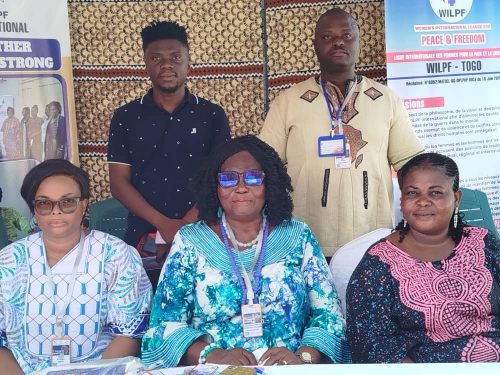
Through uncertainty and delay, WILPF Africa remained committed. Holding the vision, sustaining the planning, and affirming that Pan African work is many braiders on head.
Their decision to host the Africa Regional Meeting in Lomé, in alignment with the Congress, was a profound act of continuity and care. This was sisterhood in practice.Receiving an official invitation to the 9th Pan African Congress and the WILPF Africa Regional meeting mattered to me deeply.
It affirmed that my work as a Global African woman, a performing artivist, and an institution builder was seen and valued.
It is also why I feel a responsibility to be transparent with the public.In Malabo, Equatorial Guinea, at the African Union ECOSOCC Citizens Forum, I shared a public letter acknowledging something I believe strongly: our young people need blueprints beyond protest.
They deserve pathways toward practice, ownership, and infrastructure. In that same public space, I stated my intention to attend the 9th Pan-African Congress. Because of that declaration, I believe it is important to explain why, in the end, I did not attend personally.
By the time the Congress arrived, I had made a conscious decision. My energy was needed elsewhere. Kenya and Somaliland required my presence in ways that could not be postponed.
Recognizing Somaliland in its nationhood is Pan-African work. I stood in solidarity with African women that cover their blow outs and braided plaits under beautiful scarves.
Building cultural cooperative infrastructure in Kenya is Pan-African work. Laying foundations for a Global African Cooperative Creole Future is Pan-African work. These efforts demanded more than symbolic attendance.
They required my full attention.I did not withdraw from the Congress. I redeployed. It’s bigger than me.The institutions I helped to build, the Teaching Artist Institute, the networks of cultural workers, the cooperative frameworks, all present in Lomé.
The WILPF Africa section was in Lomé. And because those institutions were there, I was there. I am a person because we are a people. A braid added on to micro mini.As I write this, I am also holding space for the many voices that were never at the front of that room.
Not only at the 9th Pan-African Congress, but at every Pan-African Congress that has ever taken place.
The women whose labor made convenings possible, but whose names were not recorded. The cultural workers who shaped consciousness while others shaped policy.
The youth whose ideas arrived too early for their time. The organizers, translators, caretakers, artists, thinkers, and bridge-builders whose work moved quietly beneath the surface.After witnessing how this Congress unfolded, I realized something with great clarity: this moment is not unique.
I am now certain that every Pan-African Congress has unfolded in much the same way, carried by many more who were unseen.History often remembers the presidents, the speeches, the resolutions. But transformation has always depended on quieter miracles.So, this writing is also an offering to them.
Women like Alice Kinloch, Amy Ashwood Garvey, and Addie Waites Hunton—women whose labor made Pan-African gatherings possible long before their names were considered worthy of headlines.
Women who organized, fundraised, translated, strategized, and sustained movements while history focused on the men who stood at the microphone.I ask those quiet ancestors, those who did the work without the benefit of popularity, presidency, or platform, show yourself.
Because Global Africa has always been transformed by those who stood at the center and more importantly by those who held the edges, the logistics, the spirit, and just plain decided to work in a different way for whatever reason.
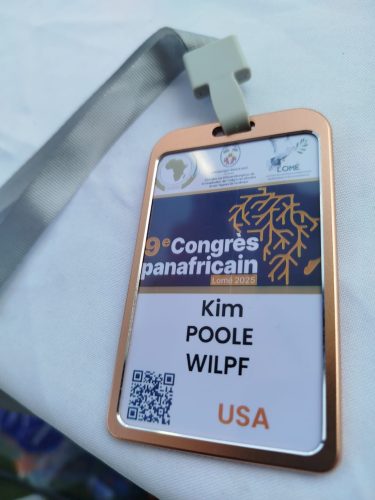
My WILPF Africa sisters making space for me as an individual Pan-African woman. Something as simple as asking someone to take a photograph of my conference badge became major to me.
It said: you belong here with us. When they welcomed my Teaching Artist Institute family from Ghana, Ewe people who refuse to acknowledge colonial borders created by parasitic systems.
Each refusal of those borders is a step toward wholeness.I do not want to merely know our Pan-African ancestors. I want to embody them in my afro puffs.
I want to translate their courage into practices that meet the needs of today’s Global Africa. That means practicing love in the face of machiavellian politics. Remaining grounded while moving fluidly, like water, around obstacles.
If the future of Pan-Africanism is to be operationalized, it will be because we learn the finger waves, french rolls.Lastly, I want to acknowledge Dr. Gnaka Lagoke and Dr. Akil Khalfani for being the first to make me aware of the 9th Pan African Congress in 2024 and keeping me informed enough to inform others.
The connectors in our ecosystem are like oxygen. May you breathe deep, stress free with hairlines that never recede.

Enock Akonnor is an experienced Ghanaian journalist, based in Kumasi and currently serves as the CEO and Managing Editor of www.leakyghana.com.
With a wealth of expertise built over many years in the media industry, he has earned a solid reputation as one of Ghana’s most sought-after journalists.
Contact:
📞 +233 541 921 562
✉️ enockakonnor2013@gmail.com